Compound Cabinet for iPhone. On the App Store in late 2026.
Know exactly what you take.
Look up a supplement, nootropic, or peptide and see what the research supports and how much of it there is. Add what you take and the app checks it against everything else in your stack. The library also holds a short list of prescriptions: ADHD medications, GLP-1s and a few others.
A confirmation when you join, one email at launch. Nothing else.
You're on the list.Launch email: the day it's on the App Store.

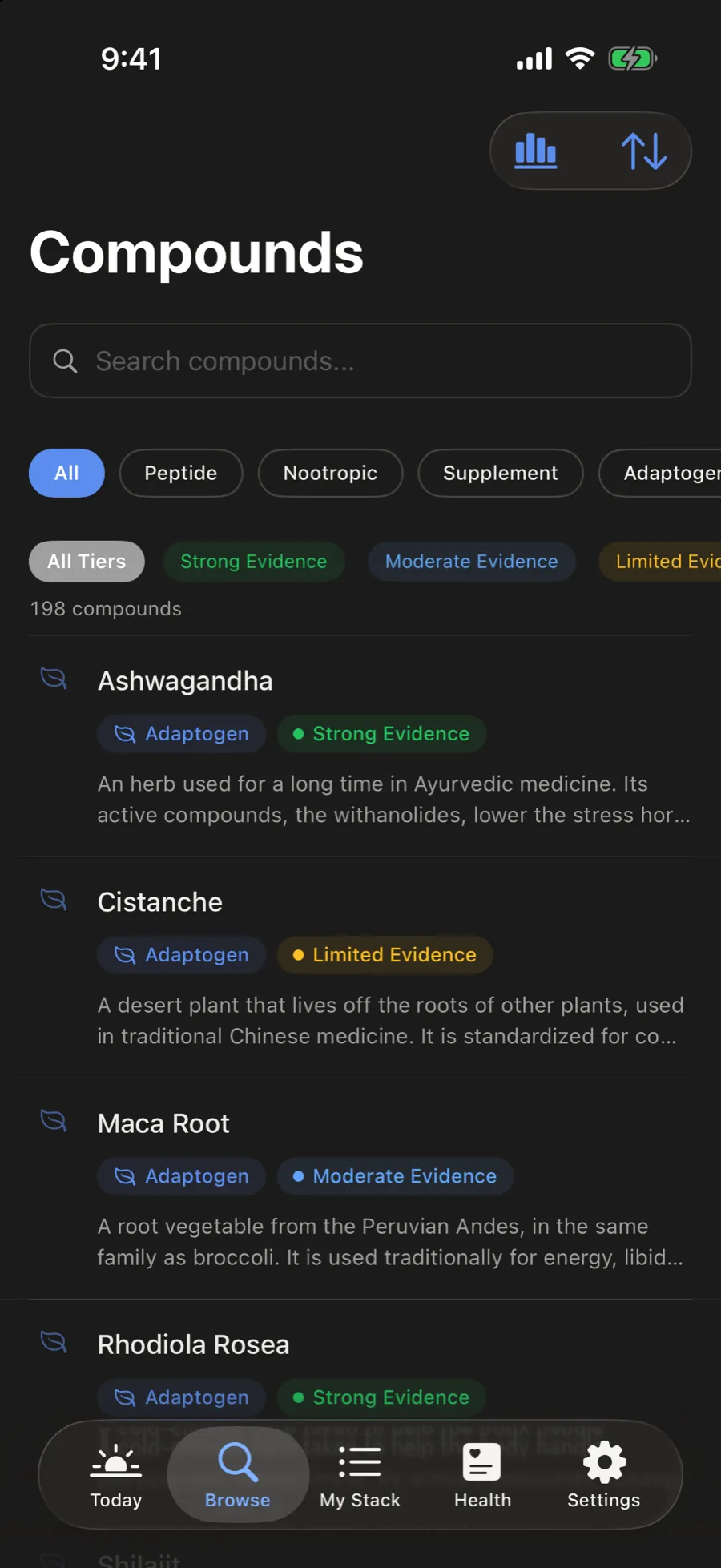
Open the cabinet.
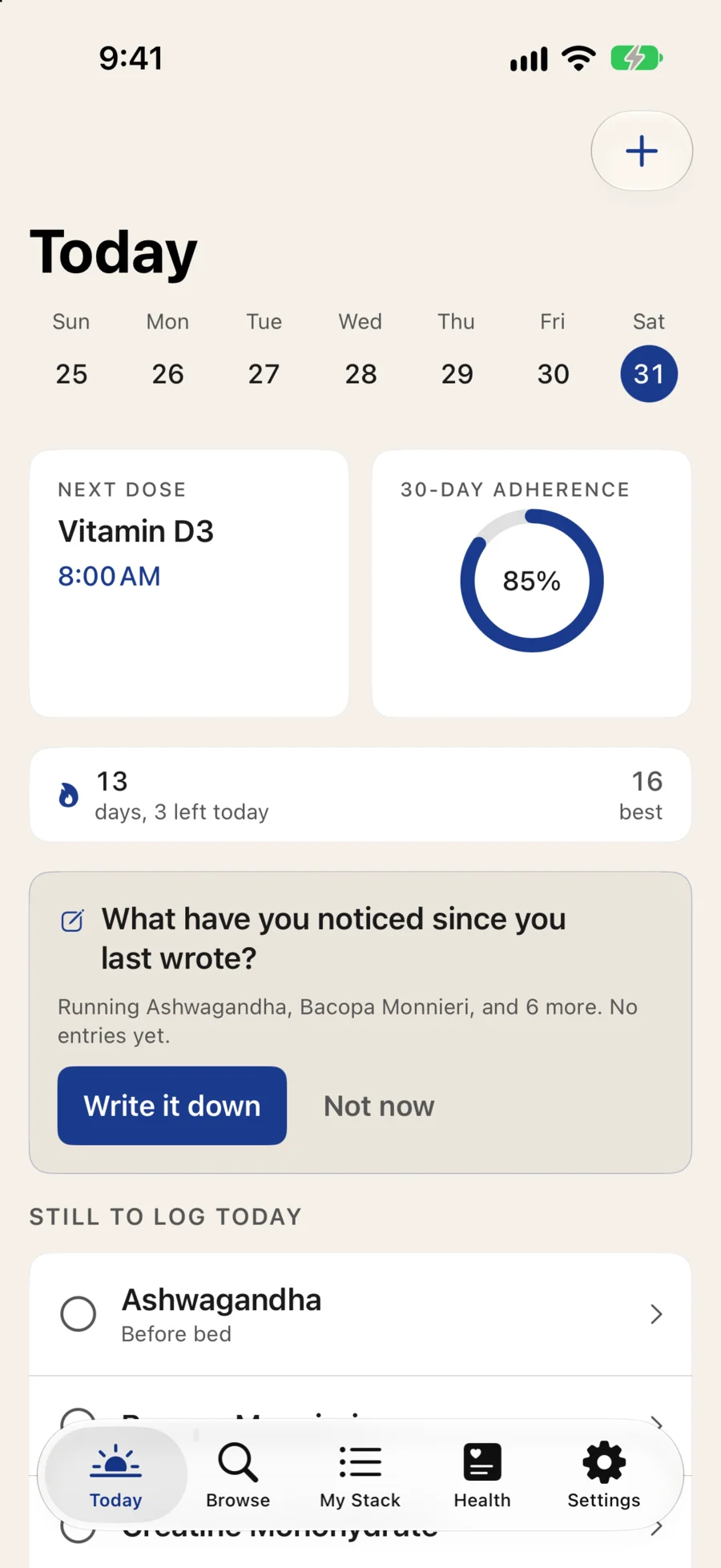
Search and filter by tier.
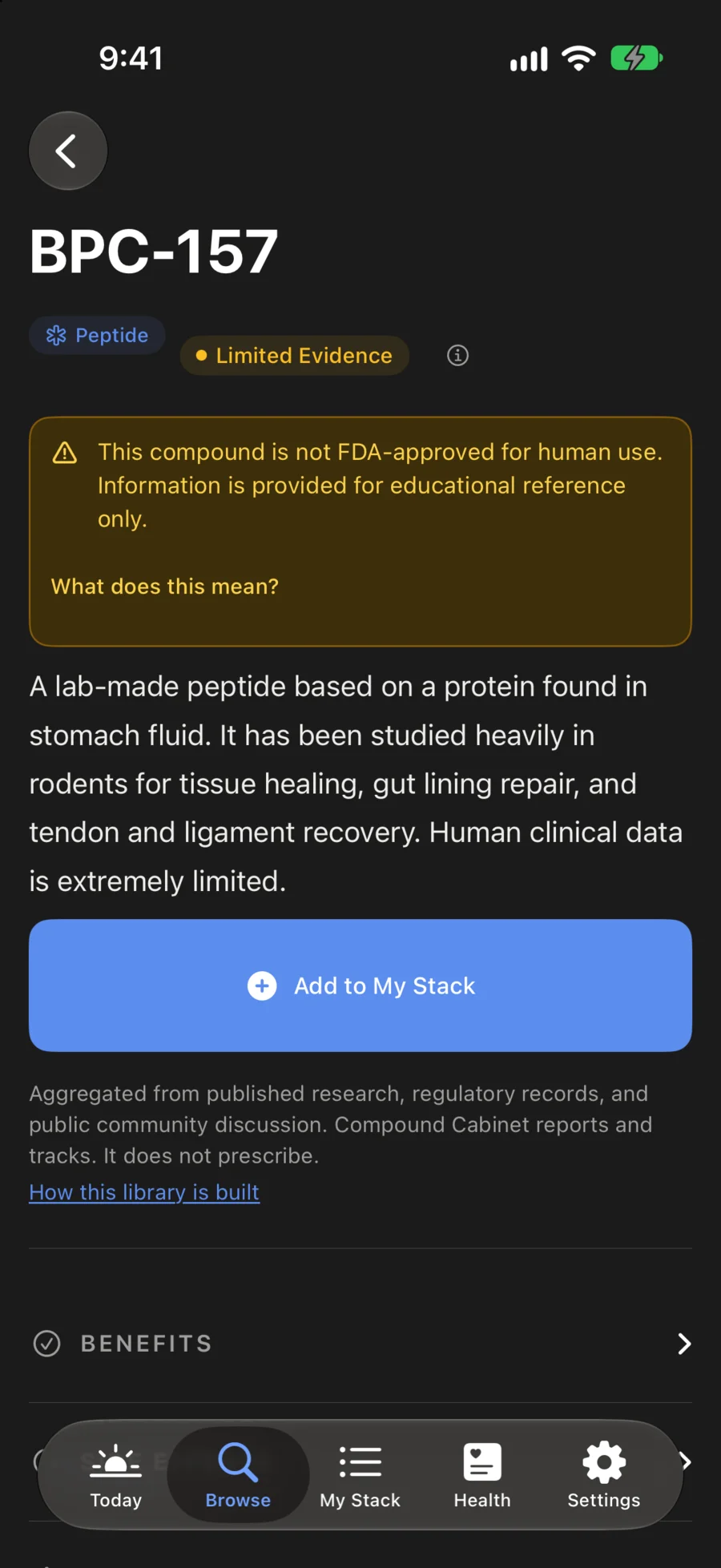
The research, graded.
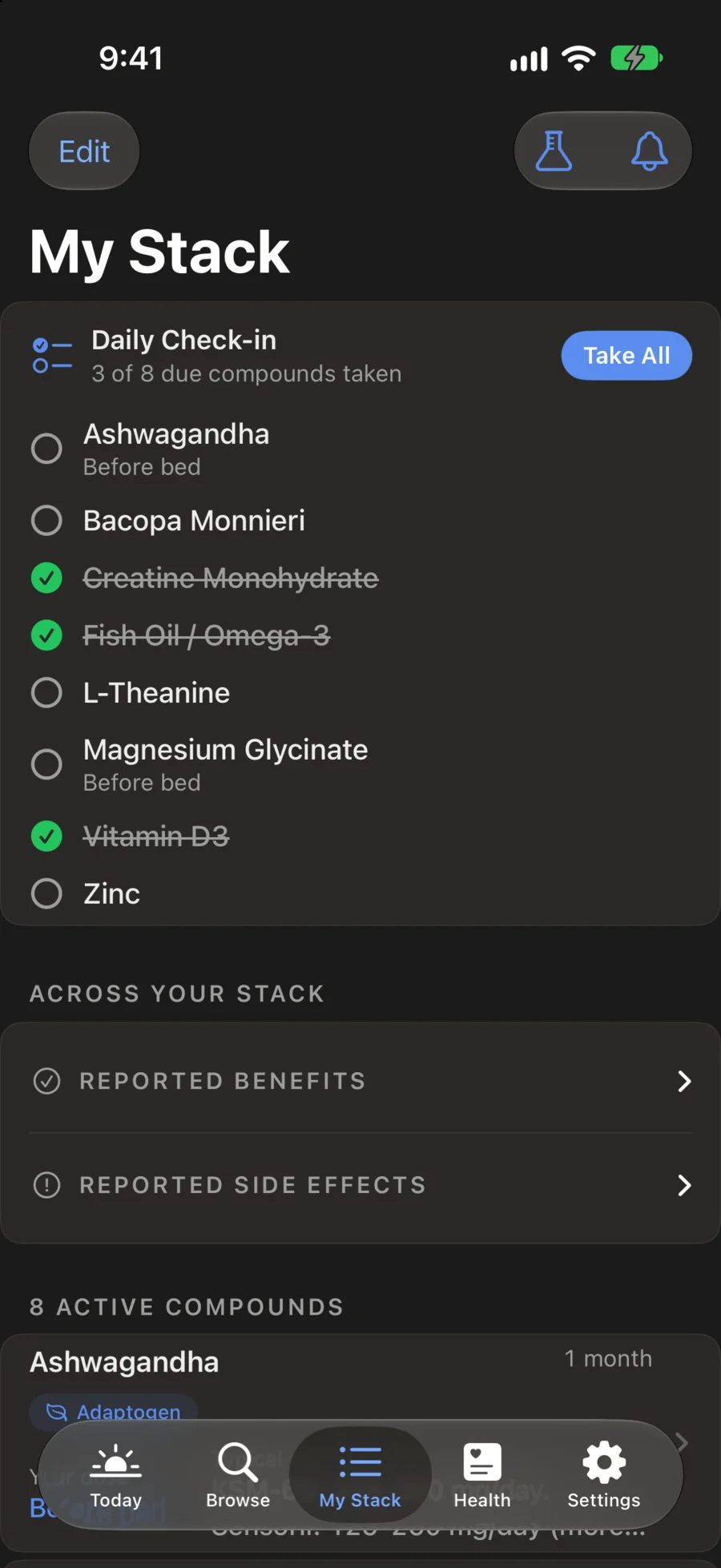
One tap a day.
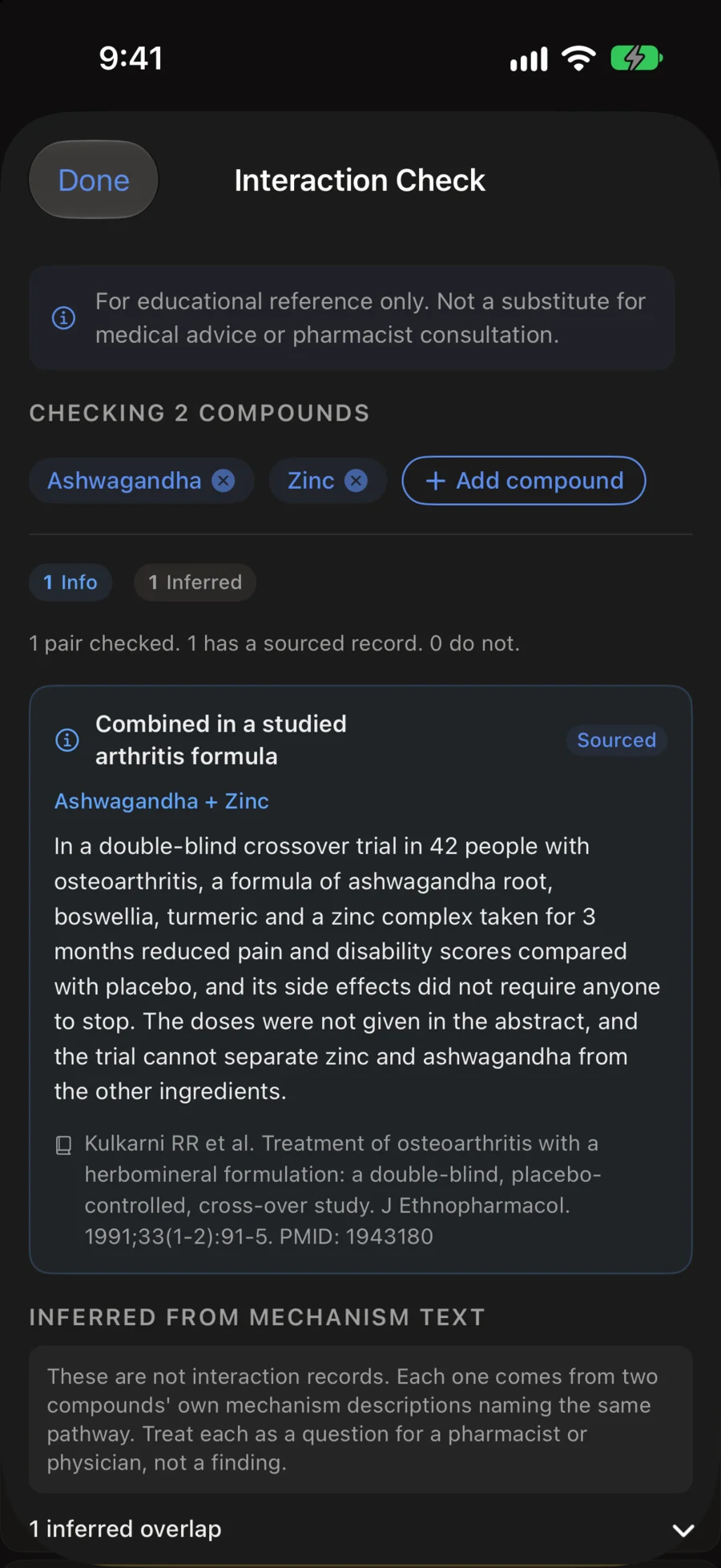
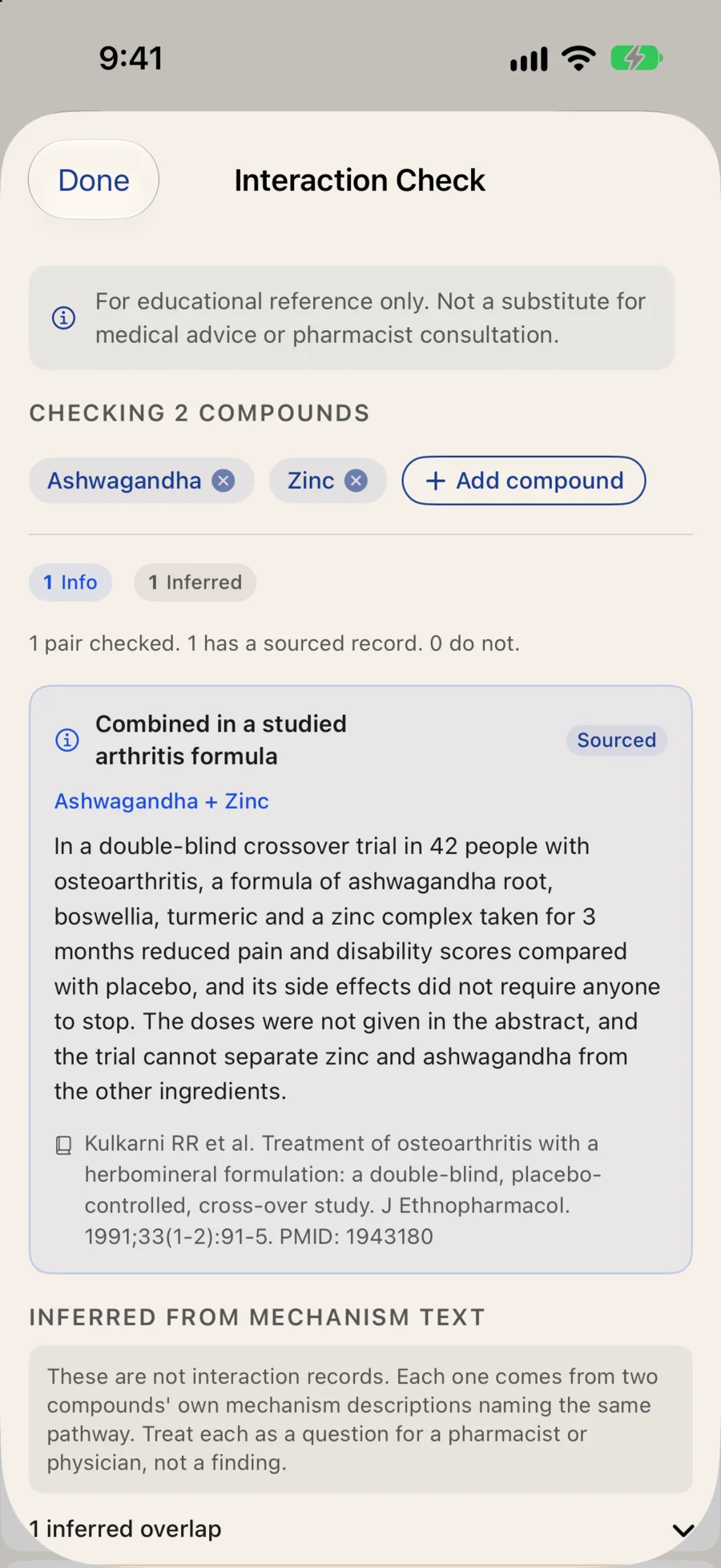
Sourced and inferred flags, labeled apart.
Search and filter by tier.
The research, graded.
One tap a day.
Sourced and inferred flags, labeled apart.
How it works
Add what you take.
Find each one in the library and add it. Some prescriptions are in there too: ADHD medications, GLP-1s and a few others.
Read the evidence.
Each entry explains the research in plain English and grades how solid it is.
See what interacts.
Every pair in your stack gets checked, and each flag shows how serious it is and where it came from.
Every entry gets a grade.
A to D, based on how much human research there is. If the only evidence is a mouse study, it says so.
- 198 compounds: supplements, nootropics, peptides, amino acids, adaptogens, and a short list of prescriptions (ADHD medications, GLP-1s and a few others). SSRIs, SNRIs and statins are not in yet.
- Each entry. What it is, what the research says, how solid that research is, and who should avoid it.
- Research compounds. Anything not approved for human use carries a notice saying so.
- What an entry says. The research on creatine, ashwagandha, L-theanine and lion's mane.
Multiple well-designed human trials point the same way. Creatine lives here.
Human evidence exists but is thinner, smaller, or mixed.
Early or indirect human data, or strong preclinical work without it.
Isolated animal or cell studies, or user reports only. No meaningful human trial evidence.
Your stack, written down.
Check things off each day and jot down what you notice. A month in, you've got notes to look back on.
- Daily check-in. One tap per compound, or take all at once.
- Journal. What changed, if anything.
- Reminders. For the things you keep forgetting.
What interacts with what.
The app checks every pair in your stack, including prescriptions you add from the library. If nothing comes up, it says nothing's on record instead of giving you a green check.
- Prescriptions. You add them yourself, and the app never reads or imports a medication list.
- Coverage. The library holds ADHD medications, GLP-1s and a few others. SSRIs, SNRIs and statins are not in yet, and most prescriptions that are in have few or no interaction records. Ask your pharmacist too.
Everything’s included, monthly or annual.
$12.99 a month or $69.99 a year, and the annual plan starts with a 14-day free trial. There's no free version.
- Every compound entry, graded
- Interaction checker, including the prescriptions in the library
- Stack tracking and daily check-in
- Journal
- Reminders
- Side-by-side comparison
- Optional backup with Sign in with Apple
- Monthly
- $12.99 / month
- Annual14-day free trial
- $69.99 / year
Works out to $5.83 a month, about 55% less than paying monthly.
Subscriptions are billed and managed by Apple. The free trial applies to the annual plan for new subscribers. Cancel anytime in Settings. Prices in US dollars; the App Store shows your local price.
What it won’t do.
Clear you to take something
If two things come back with no flag, there's no interaction on record. That's not the same as safe together, and the app tells you so on the screen.
Give you an AI to ask
There's no chatbot. Chatbots can sound certain when they're wrong, and you'd have no way to tell.
Interpret your labs
You can log a lab result and see where it falls in the range printed on your report. It won't tell you what the number means. That's your doctor's job.
Tell you what to take
Browse can point you to common starting points, or match goals you pick, and that's as far as it goes. It won't judge what's on your shelf. What you take is up to you.
Questions
Is there an app that checks how supplements and peptides combine?
Compound Cabinet is an iPhone reference app for supplements, nootropics, and peptides. It grades the evidence on each entry and shows the interaction records it has, each with a severity and, where recorded, the published source. Records are incomplete: if a pair has no record, that isn't a clearance. It only means nothing's on record.
Is this medical advice?
No. It's a reference. It doesn't diagnose, treat, or recommend anything. Ask your doctor or pharmacist before you change what you take.
Does Compound Cabinet tell me what to take?
No. It's a reference: what the research says, how strong that research is, and what's on record about combinations. Ask your pharmacist or prescriber about anything you take together.
What's in it?
198 compounds: supplements, nootropics, peptides, amino acids, adaptogens, and 32 prescription entries: ADHD medications, GLP-1s, bupropion, modafinil, some prescription peptides and post-cycle drugs, and a few others. SSRIs, SNRIs and statins are not in yet. Each entry covers what it is, what the research says, how solid that research is, and who should avoid it.
How is the evidence graded?
Four grades. A is strong, B is moderate, C is limited, and D is anecdotal. The grade reflects how much human research there is. Research compounds that aren't approved for human use carry a notice saying so. A few of the studies the library cites:
- Creatine: Kreider RB et al. J Int Soc Sports Nutr. 2017. PMID 28615996
- L-theanine and caffeine: Owen GN et al. Nutr Neurosci. 2008. PMID 18681988
- Ashwagandha (sleep): Cheah KL et al. PLoS One. 2021. PMID 34559859
- Lion's mane: Mori K et al. Phytother Res. 2009. PMID 18844328
Does it check my prescriptions?
Only if they're in the library, and only the ones you add yourself. The library holds ADHD medications, GLP-1s and a few others; SSRIs, SNRIs and statins are not in yet. The app never pulls your medication list from anywhere. Most of the prescriptions in the library have few or no interaction records yet, so if nothing comes up, that only means nothing's on record. Ask your pharmacist too.
How much is it?
$12.99 a month or $69.99 a year, and the annual plan starts with a 14-day free trial. There's no free version.
When does it launch?
Late 2026. Join the waitlist and you'll get one email the day it's out.
Is there an Android version?
Not yet. Android is planned for the first half of 2027.
What happens to my email?
It's saved with the date you signed up and which form you used, and it's only used for a signup confirmation and the launch email. It's never sold, and it's never shared with advertisers or data brokers. Use the unsubscribe link in either email, or write to [email protected] and it'll be deleted.
Where does my stack live?
On your iPhone. Signing in with Apple is optional; if you do, the app backs up your records to your account so you can restore them on a new iPhone. You can export your records as CSV files, and delete your account and its backup from Settings in the app.
Try it without installing.
Pick two compounds and see what the records say. On iPhone, scan the code or tap below.
 Open the App Clip
Know what you take.
On the App Store in late 2026.
A confirmation when you join, one email at launch. Nothing else.
You're on the list. Launch email, the day it's out.